
Last updated November 15, 2026
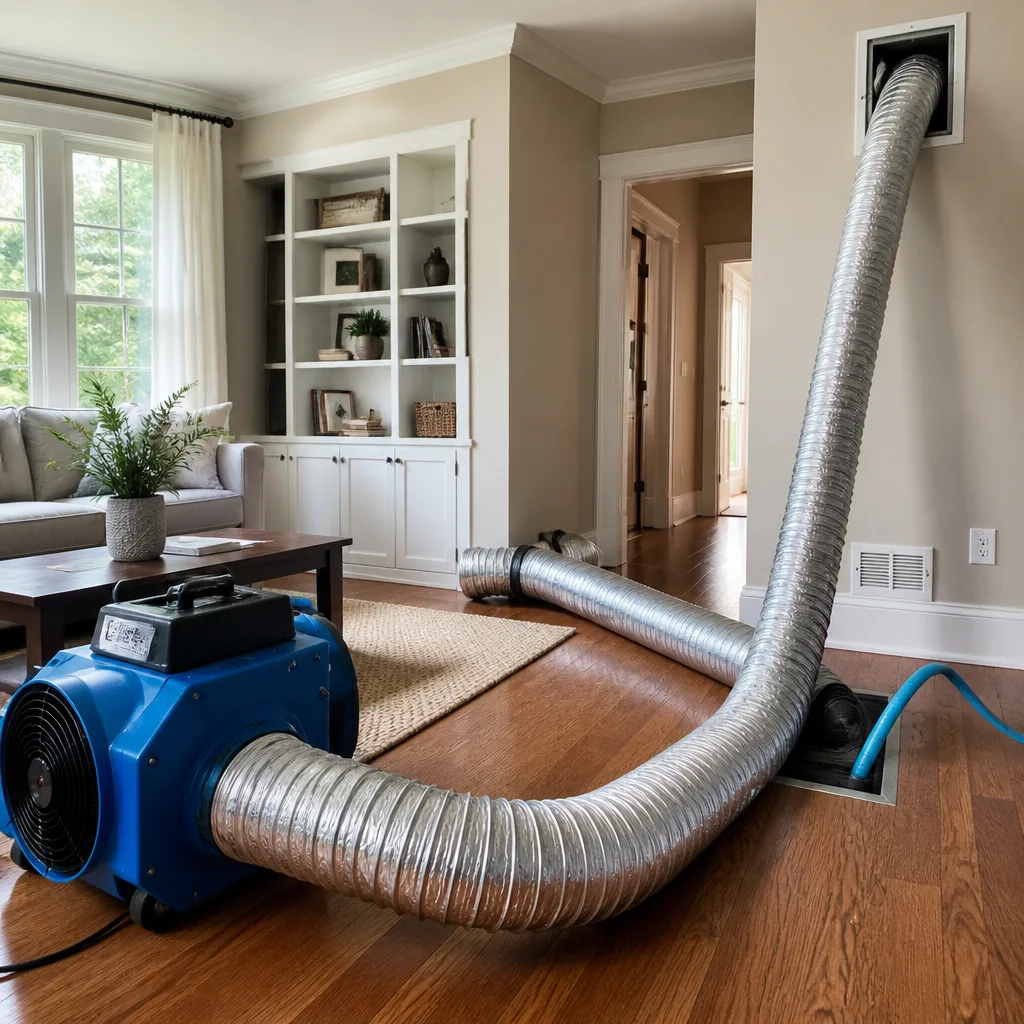 Whole-home duct cleaning
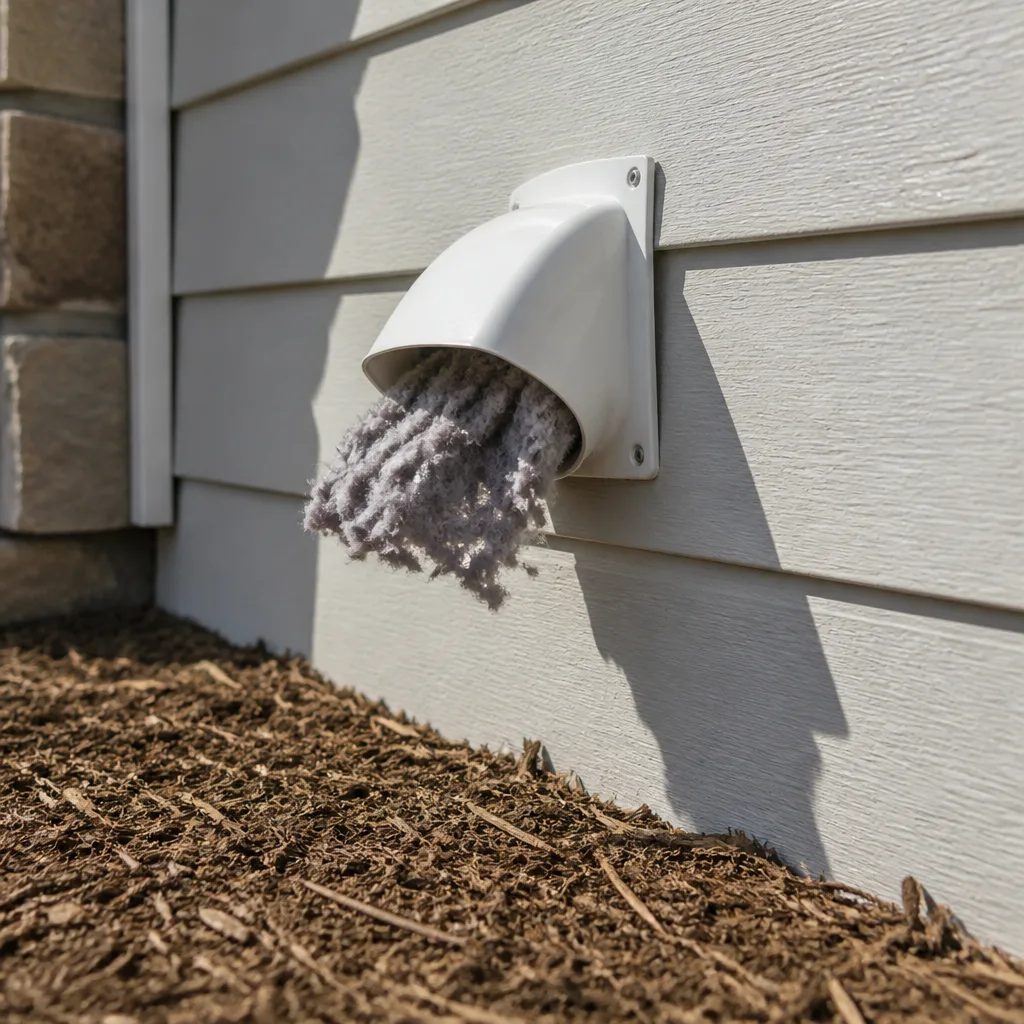 Dryer vent cleaning
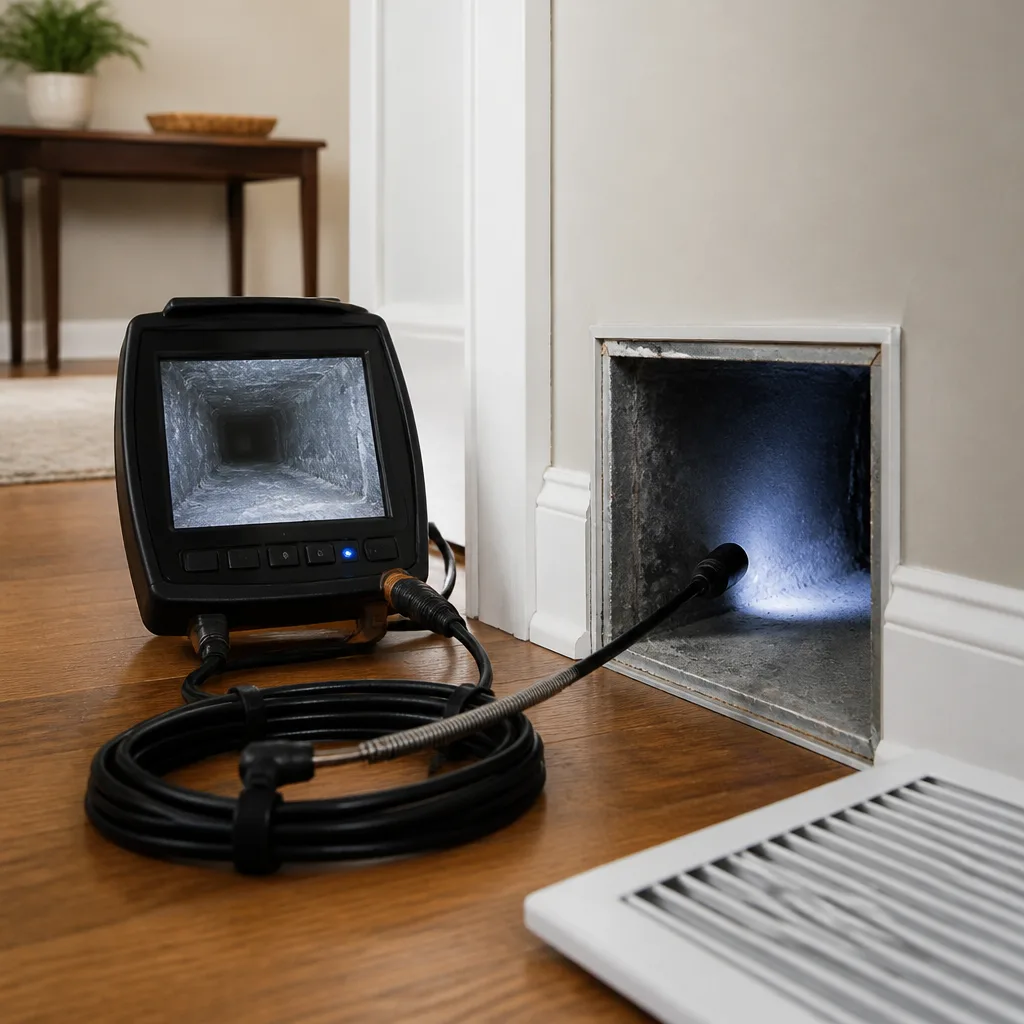 Camera inspection
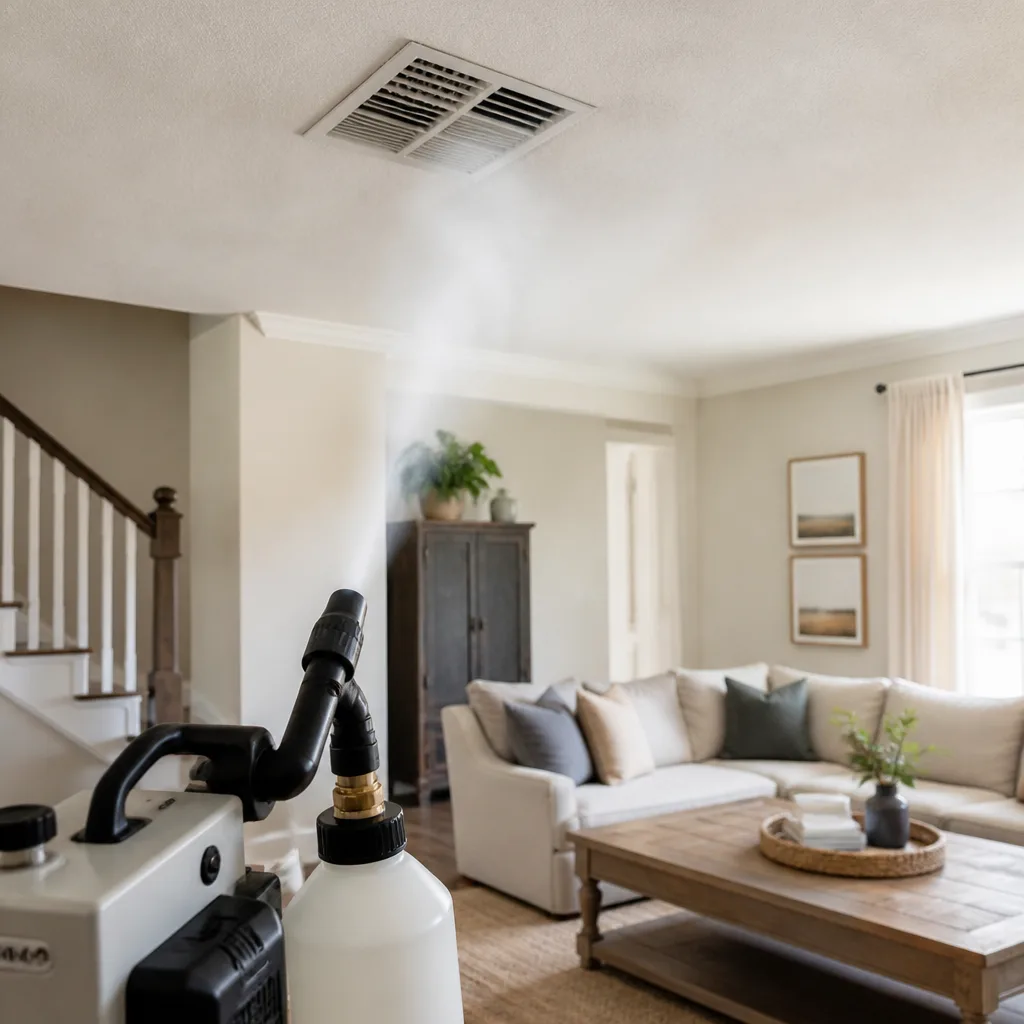 Sanitizing & deodorizing
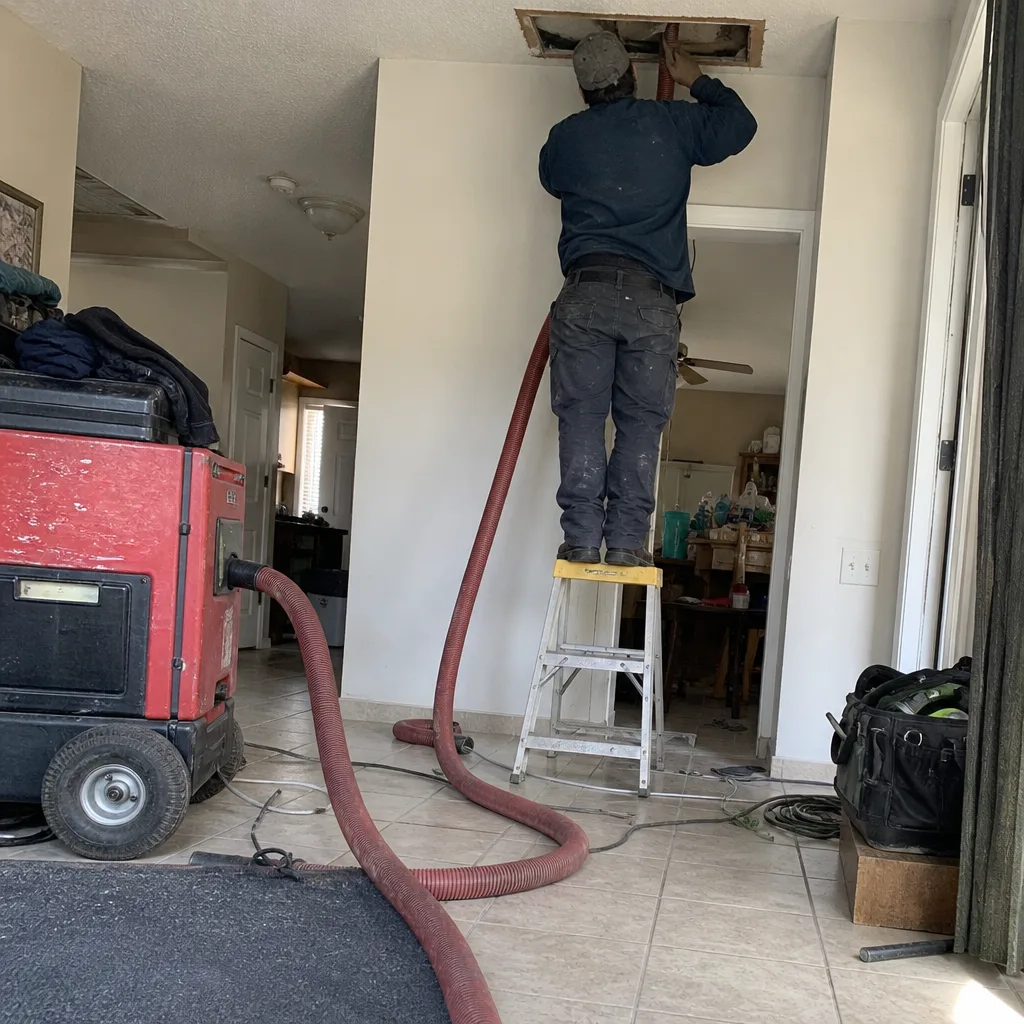
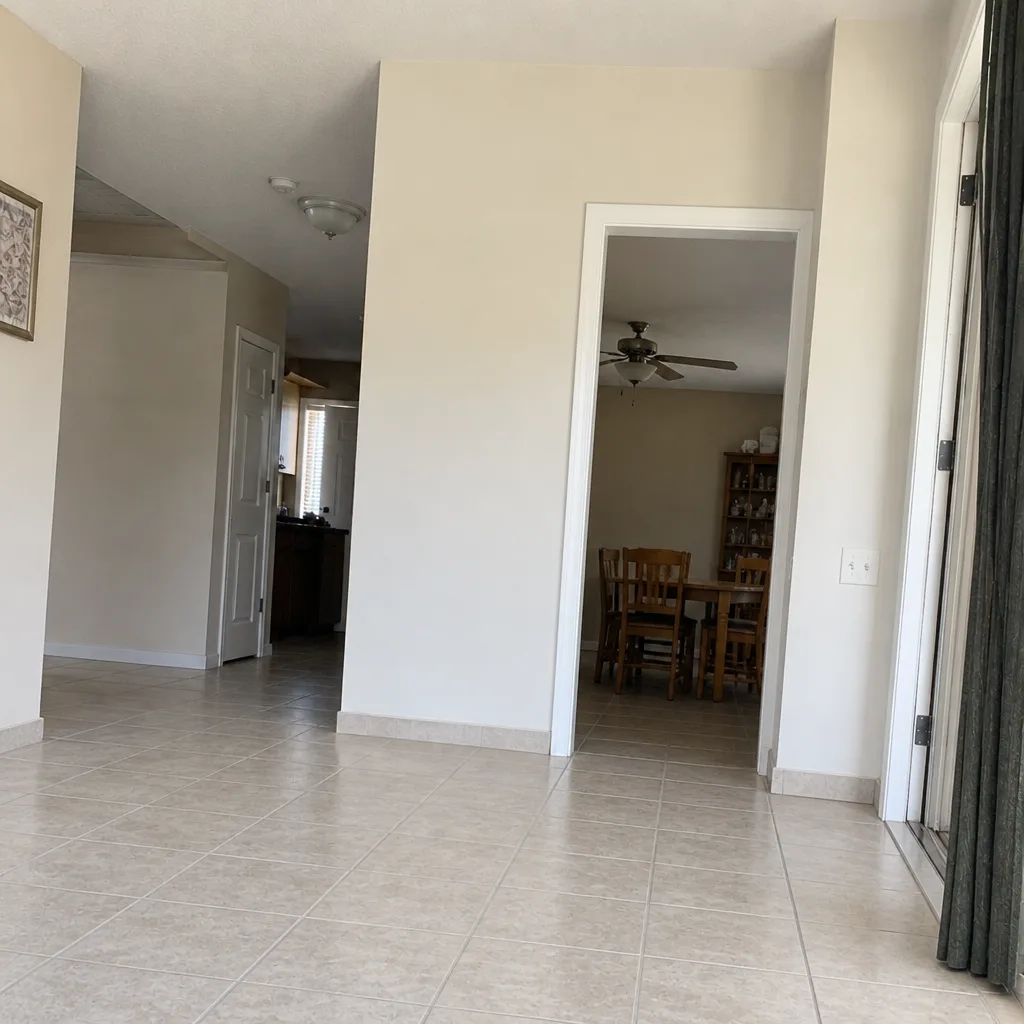
Whole-system duct and dryer vent check with before-and-after photos - you see exactly what came out of your vents
That "$99 whole-house special" is a bait ad - the real number appears once they are in your hallway, or the "clean" is a shop-vac at the register. We photograph the inside of your ducts before and after instead.
Choosing the Right Air Duct Cleaning Brand: A Buyer’s Guide for Palm Bay
Most homeowners in Palm Bay choose a duct cleaning contractor the same way they choose a restaurant: scan the reviews, glance at the price, book the one that looks fine. Almost nobody asks what equipment brand is coming through the door. That’s a mistake, because in this trade the equipment platform is the most reliable predictor of what actually happens to the inside of your ductwork. A company name tells you nothing about method. A model number does. This guide is built to help you shop by equipment rather than by logo, so the next time you hire someone for air duct cleaning in Palm Bay, you know exactly what to ask and why the answer matters.
Quick Answer
The right air duct cleaning brand in Palm Bay is the one whose equipment platform can prove source removal: integrated rotary brush and vacuum like Rotobrush, HEPA-filtration containment like Nikro, and negative-air control like Abatement Technologies. Ask any contractor to name their equipment models, the HEPA rating on their vacuum, and the CFM of their negative air unit before you book. A contractor who can explain those specifics in plain terms is signaling a genuinely different kind of job than one who can’t.
Styles & brands we work with
- Whole-home duct cleaning
- Dryer vent cleaning
- Camera inspection
- Sanitizing & deodorizing
Table of Contents
- Why Equipment Beats Logo When You Hire a Duct Cleaner
- What Rotobrush Actually Does Inside Your Ducts
- Nikro HEPA Filtration: The Containment Side of the Job
- Abatement Technologies and Negative Air: When It’s Needed
- Questions to Ask Any Palm Bay Contractor About Their Equipment
- Using Equipment Knowledge as a Screening Tool
- Why Cleaning and Repair Belong With the Same Contractor
- Dryer Vent Cleaning: A Dedicated Service, Not an Upsell
Why Equipment Beats Logo When You Hire a Duct Cleaner
In Palm Bay’s duct cleaning market, the word “professional” gets used by every operator who owns a wet/dry vac and a business phone. That makes it close to useless as a filter. Equipment doesn’t lie the same way. The machine on the job either agitates and extracts debris under controlled airflow or it doesn’t. Rotary brush systems, HEPA vacuums and negative-air units are engineered to do specific mechanical work. A shop vac, however powerful, is not.
Here’s the practical distinction. The best air duct cleaning company in Palm Bay FL isn’t the one with the biggest name or the flashiest website. It’s the one using equipment that matches the contamination profile of your system and can explain why that equipment was chosen.
Ask yourself three questions before you call:
- Does the contractor have a rotary brush system capable of mechanically agitating the duct walls, or only a vacuum hose?
- Is the vacuum HEPA-rated, meaning it captures fine particulates instead of recirculating them into your living space?
- Do they run negative-air control so the rest of the house isn’t exposed during the job?
A company that can answer those questions in specific terms has done the thinking. A company that deflects with “we use the best equipment” hasn’t. In Palm Bay’s housing stock, which mixes older block construction with newer builds, duct contamination profiles vary widely, so method matters more than a one-size approach suggests.
Our advice: ask to see the equipment. Any competent technician will happily show you the machine and explain what it’s doing. Reluctance to show it is itself information.
What Rotobrush Actually Does Inside Your Ducts
Rotobrush is a rotary contact cleaning system. A rotating brush head travels down the duct interior on a flexible shaft while high-volume vacuum draws loosened debris toward the extraction end. The key advantage is mechanical agitation: the brush physically lifts material bonded to duct walls, and the vacuum traps it before it settles elsewhere. That’s a fundamentally different process from pulling a hose through and hoping the airflow disturbs enough.
What it’s best suited for:
- Standard residential flex duct, the most common configuration in Palm Bay homes
- Sheet-metal trunk lines that have accumulated years of settled dust
- Everyday contamination profiles: dust, dander, general debris buildup from reduced HVAC efficiency
- Duct runs with accessible register openings and moderate distances from the air handler
Where it has limits:
Rotobrush is designed for contact cleaning of duct interiors, not for heavily contaminated or biologically compromised systems where airborne containment is the priority. When contamination involves moisture, growth, or a system that’s been disturbed, the containment side of the job (the next two sections) becomes the lead tool. Professional duct cleaning teams run the brush and the vacuum in coordination; one without the other isn’t a complete job.
When technicians have up to 9 years of experience behind the brush, they’ve learned to read duct conditions as they go: where the brush hangs up, where flex duct has sagged, where a run turns hard. That judgment is what separates a thorough clean from a rushed one. To understand how this fits the full scope of routine air duct cleaning, it helps to see the whole process rather than just the equipment list.
Palm Bay’s mild winters mean HVAC systems run more of the year than homeowners in colder climates realize, which accelerates dust accumulation. Brush-and-vacuum contact cleaning is the appropriate baseline response.
Nikro HEPA Filtration: The Containment Side of the Job
Nikro Industries builds HEPA-filtration vacuums and negative-air equipment used widely in restoration and remediation work. The distinction that matters for duct cleaning is HEPA filtration: the vacuum captures fine particles and contains them inside the machine rather than blowing them back into your home as a fine haze. That’s not a marketing detail. It’s the difference between removing contamination and redistributing it.
Restoration contractors gravitate toward Nikro because their job description includes managed particulates: the same logic applies to duct cleaning in occupied homes.
How HEPA filtration changes the job:
- The vacuum is sealed at the collection point, so captured material stays captured.
- HEPA-rated filters trap particles down to a very fine size, not just the visible debris.
- Airflow through the system is managed rather than improvised, so loosened material travels to extraction instead of drifting.
- Negative-air configurations can add a second layer of pressure control, which we’ll cover in the next section.
You don’t need to memorize filter ratings to hire well. You do need to ask the question. “What’s the HEPA rating on your vacuum?” is a fair, straightforward question, and a contractor who works with Nikro or equivalent equipment will answer it without blinking.
Homes near the older neighborhoods of Palm Bay, where duct systems have seen their share of turnover and renovation dust, benefit most from genuine HEPA containment. Cleaner air starts at the source, and the source is inside the duct walls, not the air moving past them.
Abatement Technologies and Negative Air: When It’s Needed
Abatement Technologies builds negative-air machines and air scrubbers used in abatement and restoration settings. In duct cleaning, a negative-air setup creates controlled airflow so the work area and the system stay under pressure during cleaning. Contaminants move toward the machine rather than into adjacent rooms.
When negative air is the right call:
- Systems with visible moisture history or conditions that suggest microbial activity
- Ductwork in homes undergoing renovation, where construction dust is present
- Widespread contamination that needs to be contained at the source, not just agitated
- Occupied homes where the owner wants maximum control over airborne particles during the job
When it’s overkill:
A routine cleaning on a lightly contaminated system doesn’t necessarily need a full negative-air configuration. Competent teams scale the setup to the system. A contractor who insists on the heaviest possible configuration for every job isn’t necessarily being thorough; they may be upselling. A contractor who never uses negative air at all is leaving a gap in their capability.
The honest answer is: it depends on what the ducts tell us. If mold remediation is needed, that’s outside the scope of cleaning and repair, and we’ll say so plainly. Duct cleaning is not a substitute for environmental remediation. Knowing the boundary is part of being an honest operator.
If you’re unsure what your system needs, a free estimate is the right starting point. Call (844) 834-5154. We answer 24/7. Fast dispatch from 7am to 7pm, Sunday through Friday.
Questions to Ask Any Palm Bay Contractor About Their Equipment
Here’s where theory becomes practical. Before you book, run through these questions. Write them down if it helps. A contractor whose “professional cleaning” claim is real will answer each one in specifics, not generalities.
- What rotary brush system do you use, and what model? “We use professional equipment” is not an answer. Rotobrush or an equivalent by name and model is.
- Is your vacuum HEPA-rated, and can you show me the filter? The filter should be visible on the machine. A HEPA label or spec sheet should be available on request.
- Do you use a negative-air machine, and what’s its CFM rating? CFM (cubic feet per minute) tells you how much air the unit can move. The number should be specific.
- How do you prevent dust from contaminating other rooms during the job? The correct answer involves negative pressure and sealed collection points, not just “we’re careful.”
- Can you show me before-and-after photos of my own ducts? Photos are the simplest proof of a complete job. If a contractor can’t produce them, ask why.
- Do you offer duct repair, or just cleaning? Cleaning and repair should be available from the same contractor, because cleaning won’t fix compromised ductwork.
Three of our go-to brands: Rotobrush for brush-and-vacuum cleaning, Nikro for HEPA filtration, and Abatement Technologies for negative air. If a contractor can’t name their equivalents, that’s your signal to look elsewhere. To see how we handle a property in Palm Bay, you’re welcome to ask what equipment we’d bring.
Using Equipment Knowledge as a Screening Tool
Once you know what to listen for, screening becomes fast. A few minutes on the phone will tell you most of what you need to know.
Green flags:
- Specific model names and brand names, delivered without hesitation
- Willingness to explain the difference between their equipment and a shop vac
- Clear description of how they contain dust during the job
- A flat price agreed before work starts, not a per-vent structure
- Before-and-after photos provided as standard
Red flags:
- Vague claims about “state-of-the-art equipment” with no names
- A low teaser price that gets renegotiated once the technician is on site
- No mention of HEPA filtration or containment
- Unwillingness to show equipment or explain method
- No repair capability, meaning a broken duct gets cleaned around, not fixed
The pattern is consistent across the market. A contractor who can’t articulate their equipment in specific terms is a contractor whose “professional” claim hasn’t been tested. In our experience, the technicians who can explain their tools are usually the ones who also do the better job, because they understand the mechanics of what they’re doing rather than following a script.
Palm Bay’s housing stock spans decades of construction, and older flex duct has often been patched, rerouted or compressed over the years. Equipment knowledge matters more than ever in systems like that, where a generic shop-vac pass wouldn’t reach the compromised sections.
Why Cleaning and Repair Belong With the Same Contractor
Cleaning a duct system with compromised ductwork is like washing a window with a crack in it. Some of the benefit leaks out. When a technician finds a separated joint, crushed flex run, or leaky seam during cleaning, the right response is to fix it, not to note it and move on. That’s why we clean and we repair, and why the two services should come from the same contractor.
What repair covers:
- Reconnecting separated or slipped joints
- Replacing crushed or improperly routed flex duct
- Sealing leaks that allow conditioned air to escape before it reaches the room
- Correcting supply and return defects that show up as uneven airflow or persistent dust
Homeowners in Palm Bay notice air duct repair as a practical need when certain rooms never cool properly or when dust returns to a freshly cleaned system. Both are symptoms of a leak somewhere in the run, not of cleaning that didn’t work.
The other half of the equation is indoor air quality equipment. Aprilaire and Honeywell products are specified by HVAC engineers for whole-home filtration and humidity control, and Guardsman covers parts that support the same systems. Installing and servicing these products is a natural extension of duct cleaning, because the goal is the same: cleaner air at the source. A contractor who understands the whole system, from the ducts to the filtration, is far less likely to hand you off to someone else for the next step.
Dryer Vent Cleaning: A Dedicated Service, Not an Upsell
Dryer vent cleaning gets treated as an afterthought in a lot of operations: a quick hand-vac pass in and out of the vent, billed on the way to the door. Done properly, it’s a different service entirely, with its own equipment and its own urgency. A clogged dryer vent is one of the leading causes of residential fires, and it also forces the dryer to run longer and hotter, which wears out the appliance.
In Palm Bay, where humidity is a permanent fact of the climate, dryer vents deal with a steady buildup of lint that turns sticky and dense. Proper dryer vent cleaning means removing that buildup from the full vent run, not just the section reachable from one end. The right tools act on the vent interior, and the right setup captures what’s loosened instead of scattering it into the laundry room.
We treat dryer vent cleaning as a standalone service because that’s what it is. It should be priced and performed as a full job, and the technician should be able to describe the equipment used. If your dryer takes two cycles to finish a load, the vent is a good place to start looking.
If you’re putting together a service schedule that covers both, start with a free estimate.
Common Mistakes to Avoid
- Hiring on price alone. A low quote often means a vacuum-only pass with no brush contact and no containment. The work looks done, but the duct walls haven’t been touched.
- Not asking for equipment specifics. “Professional equipment” means nothing on its own. The answer you want includes brand names and model numbers, or at least a plain explanation of the machine.
- Assuming the cheapest quote is the fair one. A fixed low price can turn into add-on charges once the technician is inside. A flat price per system agreed before work starts is the arrangement you want.
- Booking cleaning without repair capability. If the contractor can only clean, compromised ductwork gets cleaned around rather than fixed, and the problem returns within a season.
- Skipping the dryer vent. Palm Bay’s humid climate makes lint accumulation faster and more stubborn than many homeowners expect, and the fire risk rises with it.
- Believing the “before-and-after photos aren’t necessary” line. Photos of your own ducts are the most direct proof a complete job was performed. A contractor who skips them is asking you to take the claim on faith.
- Letting cleaning happen in an occupied home without dust control. Without negative air and sealed collection points, loosened debris drifts into living spaces and the cleaning ends up moving dust rather than removing it.
See the difference
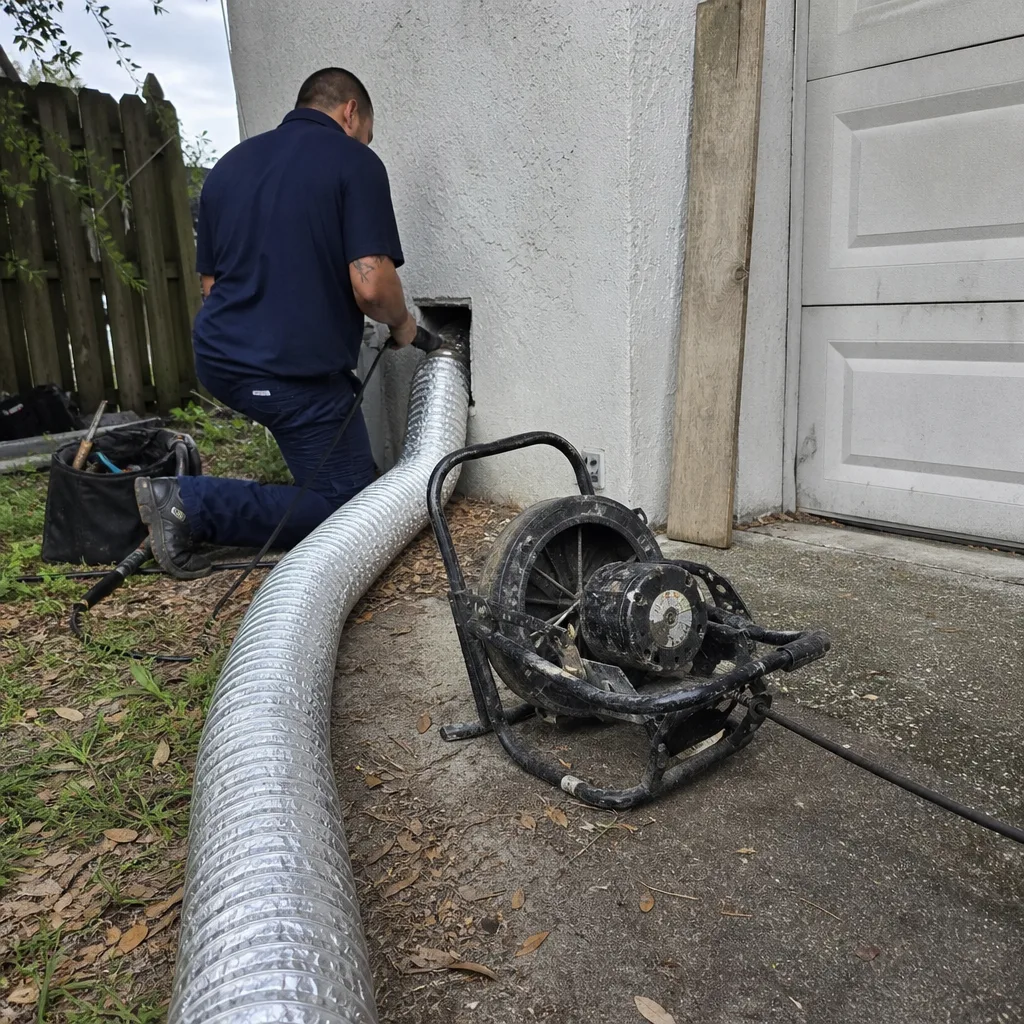 Before
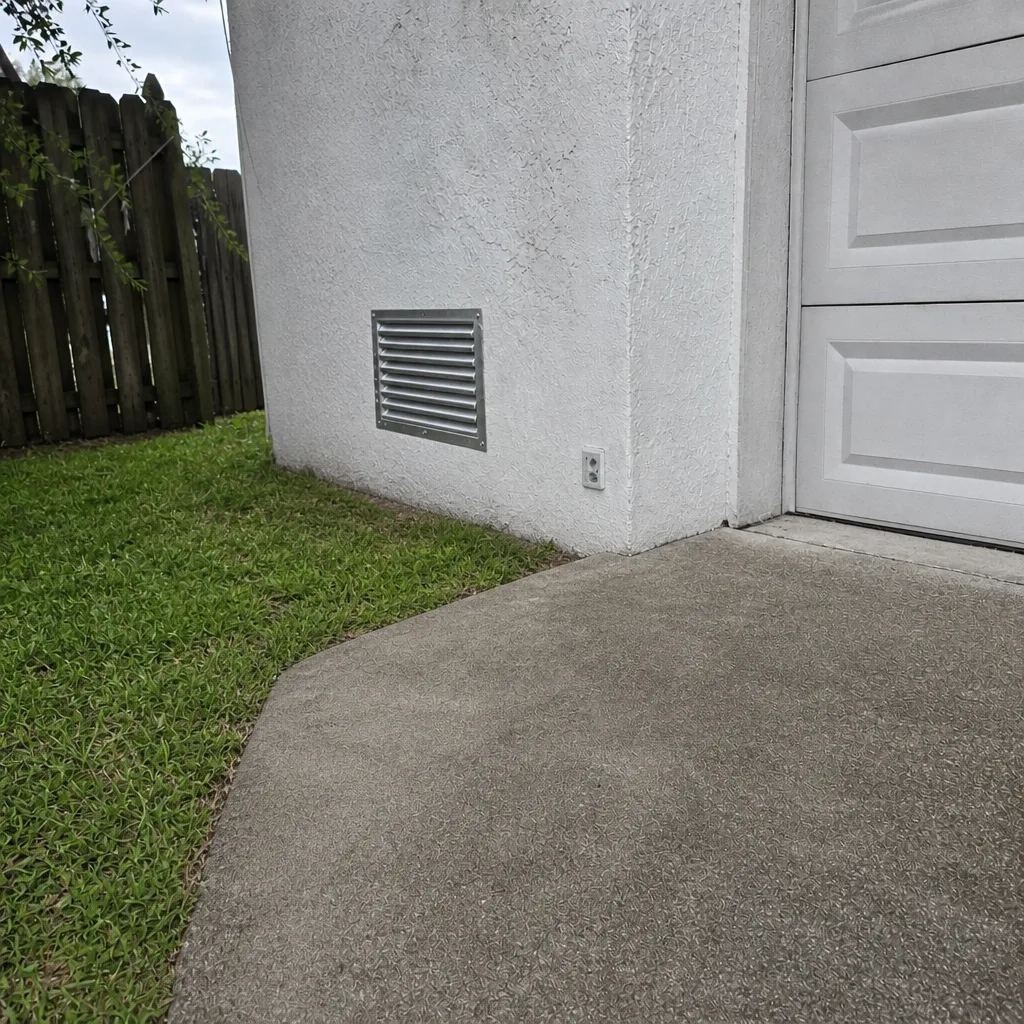 After
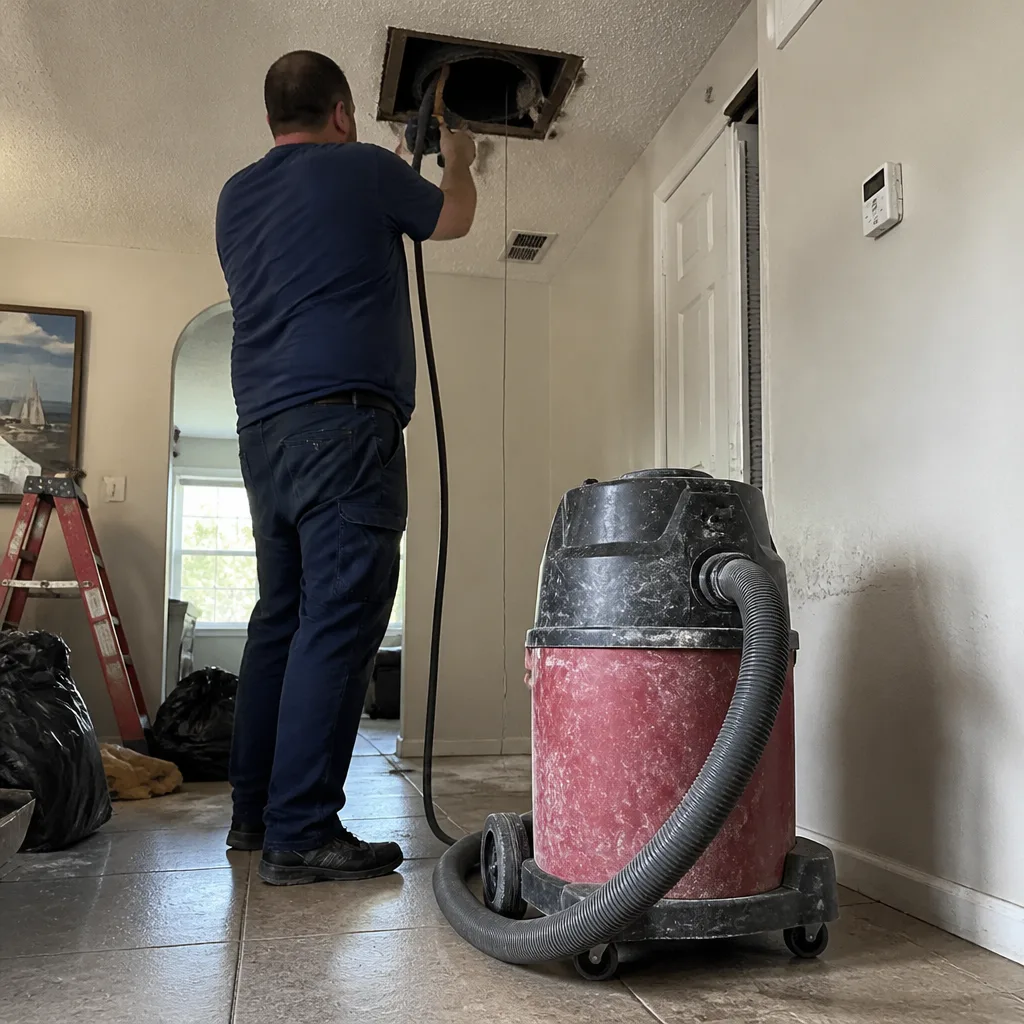 Before
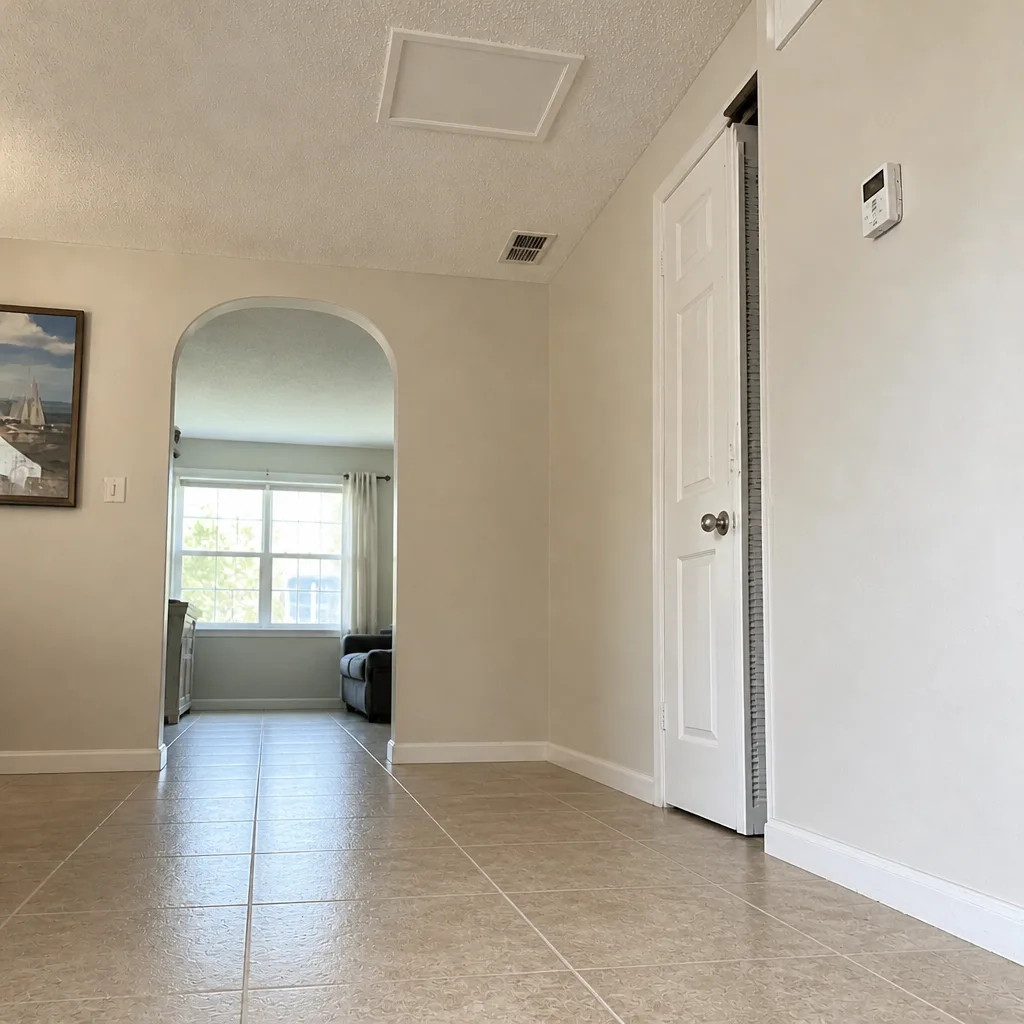 After
 Before
 After
When to Call a Professional
Call a professional when you notice a persistent dust film returning quickly after cleaning, when family members report allergy symptoms that seem tied to airflow, or when certain rooms feel stale or poorly conditioned compared to the rest of the house. A visible buildup around registers, a system that’s been through renovation work, or a dryer that takes more than one cycle to dry a load are all reasons to book an inspection. In Palm Bay, the combination of year-round HVAC use and humid air accelerates dust accumulation, which makes routine evaluation more useful than homeowners often assume.
Duct Cleaning Palm Bay offers free estimates in Palm Bay. Call (844) 834-5154. We answer 24/7. Fast dispatch from 7am to 7pm, Sunday through Friday.
Frequently Asked Questions
A whole-system cleaning in Palm Bay typically runs in the mid-hundreds of dollars, with the exact figure set by the written estimate based on system size and condition. The price is one flat figure per system, agreed before work starts, not a per-vent charge. Call (844) 834-5154 for an exact quote; estimates are free.
Cheap quotes usually reflect cheaper methods: a vacuum-only pass with no rotary brush contact, no HEPA containment, and no negative-air control. You’re not being quoted the same job at a lower price; you’re being quoted a different, shallower job. Ask what equipment is coming, and the price gap starts to make sense. Call (844) 834-5154 for a flat estimate that spells out the equipment and process.
Ask for before-and-after photos of your own ducts, and ask the technician to walk you through what was extracted and how. A complete job leaves a visible record. This is where equipment matters: brush marks on duct interiors and a sealed HEPA collection point are things you can see. Call (844) 834-5154 to book a cleaning with photo documentation.
Most Palm Bay homes benefit from cleaning roughly every three to five years, though heavy dust, pets, or recent renovation can shorten the interval. Homes with compromised ductwork may need repair before cleaning benefits show, which is why evaluation matters. Call (844) 834-5154 for a free assessment.
Yes, if there’s any chance your ducts have been patched, compressed, or rerouted, which is common in older Palm Bay homes. Cleaning a compromised system without repairing it means some of the work is wasted. Ask whether the contractor offers repair before you book. Call (844) 834-5154 with questions about your system.
A rotary brush system, a HEPA-rated vacuum, and, for many jobs, a negative-air unit. Brand names like Rotobrush, Nikro, and Abatement Technologies are a good sign because they’re professional-grade and widely used in restoration work. Ask for model numbers. Call (844) 834-5154 to ask what we’d bring to your Palm Bay home.
The Bottom Line
When you’re choosing a duct cleaning contractor in Palm Bay, the equipment platform tells you more than the company logo ever will. Rotobrush rotary brush systems do mechanical contact work, Nikro HEPA vacuums contain what’s removed, and Abatement Technologies handles controlled airflow when the job calls for it. Ask for model names, ask about HEPA ratings and CFM, and ask for before-and-after photos. A contractor who answers those questions without flinching is the one you want. For a free estimate and a clear picture of what your system needs, call (844) 834-5154. We answer 24/7. Fast dispatch from 7am to 7pm, Sunday through Friday. Or start with Duct Cleaning Palm Bay to see the full service lineup.
Written by the team at Duct Cleaning Palm Bay.